Often I will ask an audience, "How many of you are saved?" And, of course, most of the hands will go up. (It is, in that setting, the politically correct response!)
Then I will ask, "How many of you are in full-time ministry?" And only a few will go up; less than 10%.
Then I will ask again, "How many of you are saved?" And again, most of the hands will be readily visible. Then I will ask again, "How many of you are in full-time ministry?" There's a flicker of recognition of what I am driving at, and most of the hands will hesitantly begin to appear.
Yes, if we are truly "in Christ," then we should recognize that we are all called to "full-time" ministry. Even though we may provide for the economic support of ourselves and our family through a career or whatever, we are called to be His ambassadors on a full-time basis. There really shouldn't be any "part-time" Christians!
Many of us tend to dismiss the "Pastoral Epistles" as just for pastors, but they are for all of us as Christians: good, practical counsel and wisdom. Paul's three "Pastoral Epistles" are I and II Timothy and Titus. Timothy was not too happy in his church in Ephesus; Titus was in a difficult situation on the Island of Crete. To both of them Paul wrote: "Be faithful. It's too soon to quit."
Background: Paul's Ministry
Paul was arrested in Jerusalem about the year 57 A.D., and was imprisoned in Caesarea for two years.1 His voyage to Rome to be tried before Caesar started in about September, 59 A.D. After a shipwreck and a three-month wait on Malta, he arrived in Rome about February, 60 A.D.2 There, he lived in his own rented house and had liberty to minister. (Ephesians, Philippians, Colossians, and Philemon were written during this first Roman captivity.)
Paul was acquitted of the charges against him and released. During the two years that followed, he ministered in various places and wrote I Timothy and Titus. About 65 A.D. Paul was arrested again, and this time put into a dungeon. It was then that he wrote II Timothy, his last letter.
Timothy
Timothy was Paul's young protégé and became one of Paul's most constant companions. Timothy was the son of a Greek father and a Jewish mother.3 His mother Eunice and grandmother Lois were both known for their sincere faith.4 Timothy already knew and believed the Old Testament Scriptures, thanks to his mother and grandmother.5
Timothy was no doubt living at Lystra when Paul visited that city on his first missionary journey.6 Timothy's promise for the ministry was recognized early.7 Paul thus became like a spiritual father to the young man. Apparently certain prophetic utterances confirmed Timothy's appointment.8
Paul took him on as a companion and Timothy became one of the apostle's most trustworthy fellow laborers.9 He also became Paul's faithful representative and messenger.10 Six of Paul's epistles include Timothy in the salutations.11
Timothy's mixed parentage caused Paul to have him circumcised.12 This appears contrary to the decision of the Jerusalem Council held shortly before the second missionary journey.13 This mixed parentage could have become an occasion for serious offense in Jewish circles if he had remained uncircumcised and Paul wanted to maximize the effectiveness of Timothy's ministry. (Titus was not compelled to be circumcised.14)
After being released from his first Roman imprisonment Paul, with Timothy by his side, evidently revisited some of the churches in Asia, including Ephesus. On his departure from Ephesus, despite his youth, Paul left Timothy behind to provide leadership to the congregation. Then after an interval Paul wrote Timothy a letter, I Timothy, encouraging him on in that ministry.
Timothy may have been by nature somewhat passive, timid, retiring, and easily intimidated.15 Thus Paul repeatedly spurred him into action.16 He was to let nothing, including his relative youth, stand in the way of his performance of duty.17 Timothy was indeed rather young: Paul's exhortation "let no one despise your youth" was even given 15 years later.18
Yet, despite his gifts and his close association with Paul, Timothy was easily discouraged. The last time Paul had been with him, he had encouraged him to stay on at Ephesus and finish his work.19 Ephesus was not the easiest place to minister. (Are there any "easy" places?)
Paul's messages to Timothy are for us today. Times are changing, and it is becoming increasingly "politically incorrect" to be a Bible-believing Christian. We could very well be facing some dark times ahead and this personal counsel and management advice may well have more import to each of us than might appear on the surface!
Timothy had become so dear to Paul that in the apostle's last message there was a touching appeal for Timothy to join him in his final days of imprisonment.20
Titus
Titus was Paul's troubleshooter. Converted early in Paul's ministry, he accompanied Paul and Barnabas on their visit from Antioch to Jerusalem regarding the Gentiles and the ceremonial law.21 They debated with the leaders over the position of non-Jews in the church. Titus was probably the only Greek present.
Paul used Titus to help sort out some extremely delicate situations. Paul used him on a sensitive diplomatic mission to the church in Corinth. Titus took a severely worded letter from Paul to the Corinthians, tackling their unruliness which called for firmness and tact - from which Apollos appears to have shrunk.22 He was also given instructions by Paul to enforce at Corinth. When Paul and Titus later met in Macedonia, Titus had achieved a lot of what Paul had asked for.23
Ten years later, Titus was again selected to deal with another difficult and challenging position in Crete: to combat quarrelling and slander by rebuking his hearers and using his full authority to bring order.
Sounds like these experiences should have a great deal of relevance to our own churches today, doesn't it? The timeliness and relevance to our own problems in our own fellowships - and the spiritual dangers we face - is one of the compelling reasons to glean what the Holy Spirit has in store for you in these treasured letters.
We take advantage of "e-mail" from our friends and mentors. These letters are the "s-mail" from the Holy Spirit to comfort and assist us with the spiritualchallenges we face in our fellowships. Good hunting!
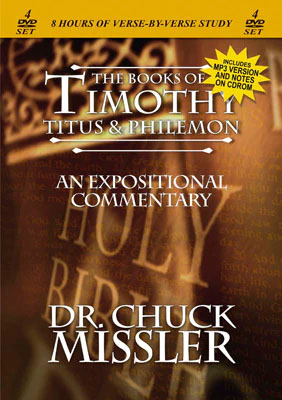
Our I & II Timothy/Titus Commentary is now available in MP3 on CD-ROM.
Notes:
- Acts 21:19 - 26:32.
- Acts 27-28.
- Acts 16:1.
- 2 Tim 1:5.
- Cf. 2 Tim 3:15.
- Cf. Acts 14:6; 16:1.
- 1 Tim 1:18; 4:14; 2 Tim 4:5.
- 1 Tim 1:18; cf. 4:14.
- Cf. Rom 16:21; 1 Cor 16:10; Phil 2:19-23; 1 Thess 3:2.
- Acts 19:22; 1 Cor 4:17; 2 Cor 1:19; Phil 2:19; 1 Thess 3:2, 6.
- 2 Cor 1:1; Phil 1:1; Col 1:1; 1 Thess 1:1; 2 Thess 1:1; Philemon 1.
- Acts 16:3.
- Acts 15:27-29.
- Gal 2:3.
- Cf. 2 Tim 1:7.
- 1 Tim 1:3; 4:11; 5:7; 6:2; 2 Tim 3:14; 4:2, 5.
- 1 Tim 4:12; 2 Tim 2:1-7; 4:5.
- 1 Tim 4:12.
- 1 Tim 1:3.
- 2 Tim 1:4; 4:9, 21.
- Acts 15; Gal 2:1-4.
- 1 Cor 16:12.
- 2 Corinthians 2:12-13; 7:5-16.